
When everything changes, your story needs to change
A value proposition is a strategic document that organises your thinking about what you offer to whom and sets the necessary clarity for you to deliver on your promise. But a value proposition on its own cannot move anyone, because people do not make decisions in response to well-organised arguments: they make them in response to what they feel. Narrative builds the bridge between the two, translating strategy into emotional resonance.
When the context around us shifts, the brand must adapt to the new situation and the narrative must evolve with it.
The outer layers
A brand story is a layered construction that needs articulated thinking. I created a storytelling model (published in my book Habla con el Corazón) that maps these layers from the outside in, beginning with the broadest contextual conditions and moving toward the elements that generate emotional power. The outermost layer is context itself, and sitting within it is the framework through which your public interprets what you do: the mental model they bring to your field and your role within it, and if that framework has shifted the way you position your value proposition may need to shift with it.
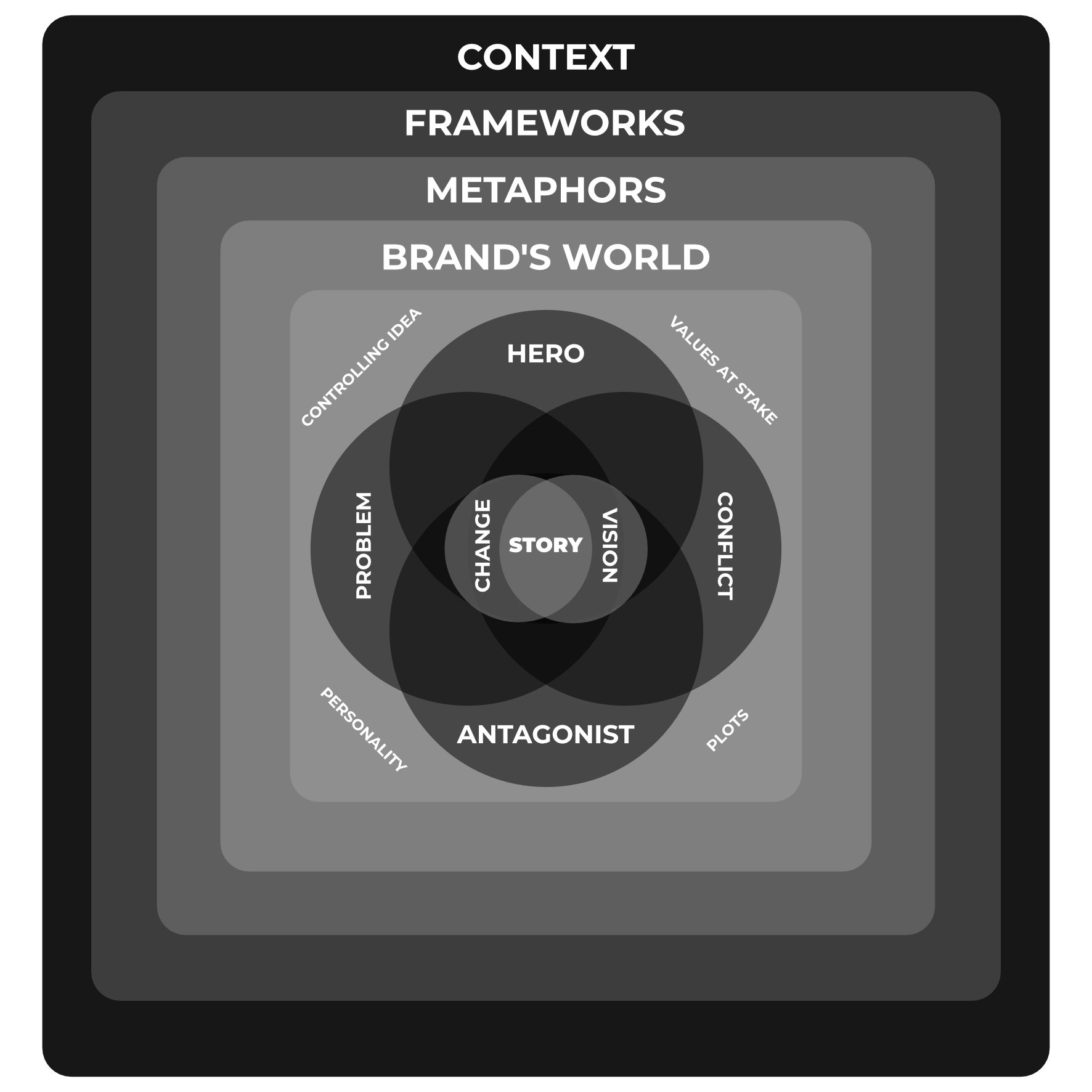
© Giuseppe Cavallo
Metaphors sit inside the framing layer and deserve particular attention, because they shape the emotional relationship your public has with what you offer. So, when context changes the metaphors that once resonated may no longer activate the right response. A financial adviser who describes her work through the metaphor of security builds a fundamentally different relationship from one who uses the metaphor of a journey toward a goal, and that difference matters in the light of changing context. In times of uncertainty, for instance, journeys are a source of anxiety and the metaphor may trigger rejection.
The brand's world is the imaginative universe your narrative inhabits: the tone, the territory, the register that makes your story recognisable as yours, and when the context shifts significantly it may need expansion or reorientation.
The inner layers
The values at stake are what give the story its urgency, and a narrative gains emotional power when something important is in play. If the context has changed what your public considers important, you may need to recalibrate the story accordingly, to ensure that what your narrative puts at stake is what your public currently finds urgent.
The controlling idea is the central argument of your story: a single formulation that contains both the cause and the value it produces, and it may be entirely stable through a period of change or may need sharpening in response to a new landscape, but either way it is worth examining deliberately rather than assuming it still holds.
The narrative pillars (or plots) are the recurring themes through which your story expresses itself across different contexts and formats, and they are typically the first elements to feel the pressure of contextual change because they are the most exposed. If new conversations have become dominant in your field and the concerns of your public have moved, the pillars that once gave your narrative variety and relevance may need to be rebuilt around new thematic territory.
Antagonist and conflict
At the centre of the model I put the two elements that determine whether a story actually works: the antagonist and the conflict.
The antagonist is the force that stands between your public and the outcome they want, and when context changes it often changes with it or takes on new characteristics, so the antagonist needs to be current and recognisable to the people you serve. A CFO whose antagonist was once operational inefficiency may now face one shaped by the speed of technological disruption, and that is a meaningfully different story.
The conflict is the deeper question and the one that matters most, because every story that truly moves people does so by addressing an internal tension or an unresolved question of the audience. There are two different types of conflict. The external conflict clarifies the difficulty of overcoming the challengeas in front of us. The internal conflict, instead, asks us to look within and understand what inner transformation we need to endure in order to be able to face the external conflict. When you assess whether your story needs to change, the internal conflict of your public is the question to ponder longest. If the people you serve are carrying different uncertainties than they were a few years ago, the story needs to meet them where they are now.