
How you can elevate your personal brand with a symbolic narrative
Narrative coherence becomes much easier when you understand the nature of your symbolic dimension.
There is an important distinction to make here.
Positioning is a strategic choice. It consists in focusing on a specific part of your value proposition so that you occupy a distinctive place in the mind of your public. It is deliberate, analytical and explicit, and it concentrates on the value that you offer, whether that value lies in resolving problems, connecting through emotions or inspiring direction.
While positioning defines what you offer, symbolism defines what you represent. While positioning reflects your aspiration to control how a person in your public sees you, symbolism relies on her heuristic brain activity to establish a relationship grounded in what she finds meaningful and inspiring.
When both align, narrative strength emerges naturally.
To make this practical, I developed a model that helps identify four symbolic prototypes that frequently appear in personal branding.
The model is built on two axes. On the horizontal axis we find Experience, which ranges from helping to elevating. On the vertical axis we find Narrative, which ranges from informing to inspiring. When these two dimensions intersect, they generate four dominant symbolic zones:
Rescue, associated with protection and reliability.
Transform, associated with renewal and movement.
Resolve, associated with guidance and clarity.
Boost, associated with energy and momentum.
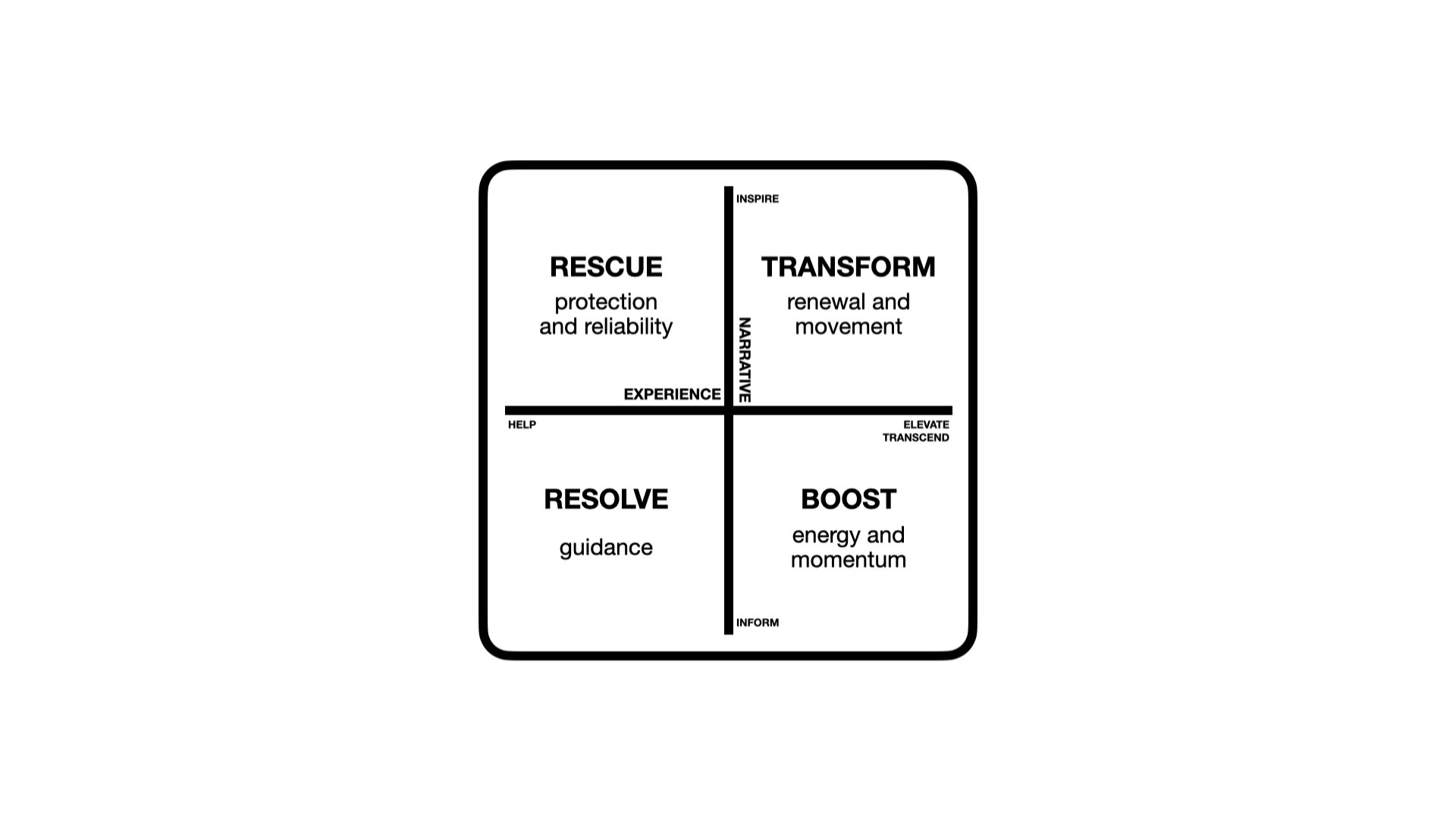
Each quadrant represents a different way in which a personal brand can crystallise into a recognisable symbolic presence.
Let us look at how narrative operates in each one.
Rescue: protection and reliability
In the Rescue quadrant we find figures who inspire while offering psychological safety and human reassurance.
Brené Brown is a powerful example.
Her work on vulnerability and courageous leadership has positioned her as a thought leader. Yet her symbolic dimension goes deeper. She represents emotional safety in leadership and has offered leaders the possibility to name emotional burdens that trapped them into suffering and inefficacy. She makes complexity feel manageable and gives language to experiences that were previously silent.
Her narrative revolves around dignity, courage and belonging. Through repeated themes and a consistent tone, she has become a symbol of humanised leadership. That symbolic presence allows her positioning to resonate deeply.
Transform: renewal and movement
In the Transform quadrant we find figures who inspire structural change and embody movement.
Paul Polman represents this clearly.
During his years at Unilever, he reframed the role of business in society. He integrated sustainability into corporate strategy and spoke consistently about long-term value creation. His symbolic dimension lies in renewal. He represents the idea that corporations can evolve from extractive models toward responsible stewardship.
His narrative works because it is coherent. He repeatedly frames business as a force for systemic change. Over time he has become associated with sustainable capitalism. The symbolic layer reinforces the strategic positioning.
Resolve: guidance and clarity
In the Resolve quadrant we find figures who inform while offering practical orientation and actionable understanding.
Jim Kwik is a strong example.
He symbolises cognitive clarity and optimisation. His narrative revolves around practical techniques that improve memory, focus and learning capacity. He presents himself as a guide who helps you unlock mental potential through concrete methods.
The symbolic dimension here is competence combined with accessibility. He represents clarity in complexity. His positioning as a brain performance expert becomes stronger because his symbolic identity reinforces trust in his how-to approach.
Boost: energy and momentum
In the Boost quadrant we find figures who inform while elevating performance and expanding potential, often elevating our sense of self in the process.
Andrew Huberman illustrates this quadrant well.
Huberman communicates neuroscience in a structured and evidence-based manner. At the same time, he projects a disciplined, optimised lifestyle that reflects self-mastery. His symbolic dimension revolves around elevation. He represents the idea that scientific knowledge can be applied to upgrade the self.
His narrative integrates research, routines and practical application. Over time he has become associated with performance optimisation grounded in science. The symbolic layer amplifies the authority of his positioning.
The underlying coherence
These figures are complex human beings. Their lives cannot be reduced to a quadrant.
What matters is their symbolic dominance.
Each of them occupies a primary zone where experience and narrative align in a coherent way, and that alignment produces symbolic clarity, which strengthens narrative consistency and deepens symbolic recognition over time.
When you understand your symbolic dimension within this matrix, storytelling becomes much more straightforward. You no longer need to invent angles or search for themes. You simply articulate, again and again, the kind of impact you genuinely create. Over time, people begin to associate your name with a clear and familiar presence.