
Designing the symbolic architecture of your personal brand
In another article, I explored why symbols are powerful. They work because they align with how our brain actually functions. They compress meaning, accelerate recognition and shape decisions in ways that operate below conscious analysis.
The question now becomes practical. How do you design that symbolic power intentionally?
Symbolism in personal branding operates on two levels. On one level, your personal brand itself becomes a symbol. On another level, you use symbols as a language to reinforce and communicate meaning. Both levels require awareness and deliberate choices.
Choosing what you symbolise
In issue #16, dedicated to meaning, we worked with a matrix built on two axes: Experience on the horizontal axis and Narrative on the vertical axis. Their intersection generated four quadrants: Rescue, Transform, Help and Boost. At the time we used this framework to think about value creation. It can also help you clarify what you symbolise.
Every strong personal brand ends up representing a specific type of contribution in the lives of others. The experience axis asks what kind of impact you consistently create in reality. The narrative axis asks how you frame that impact in the story you tell about your work and about the world.
When you cross these two dimensions, you move beyond defining services and begin to clarify the archetype you embody.
If your impact consists in stabilising complex situations and restoring order, you are operating in the Rescue quadrant and you symbolise protection and reliability.
If your work revolves around changing structures, shifting mindsets and redefining direction, you sit in Transform and you symbolise renewal and movement.
If your core contribution lies in accompanying others, helping them grow and navigate uncertainty, you operate in Help and you symbolise guidance.
If you focus on raising performance and accelerating existing potential, you are in Boost and you symbolise energy and momentum.
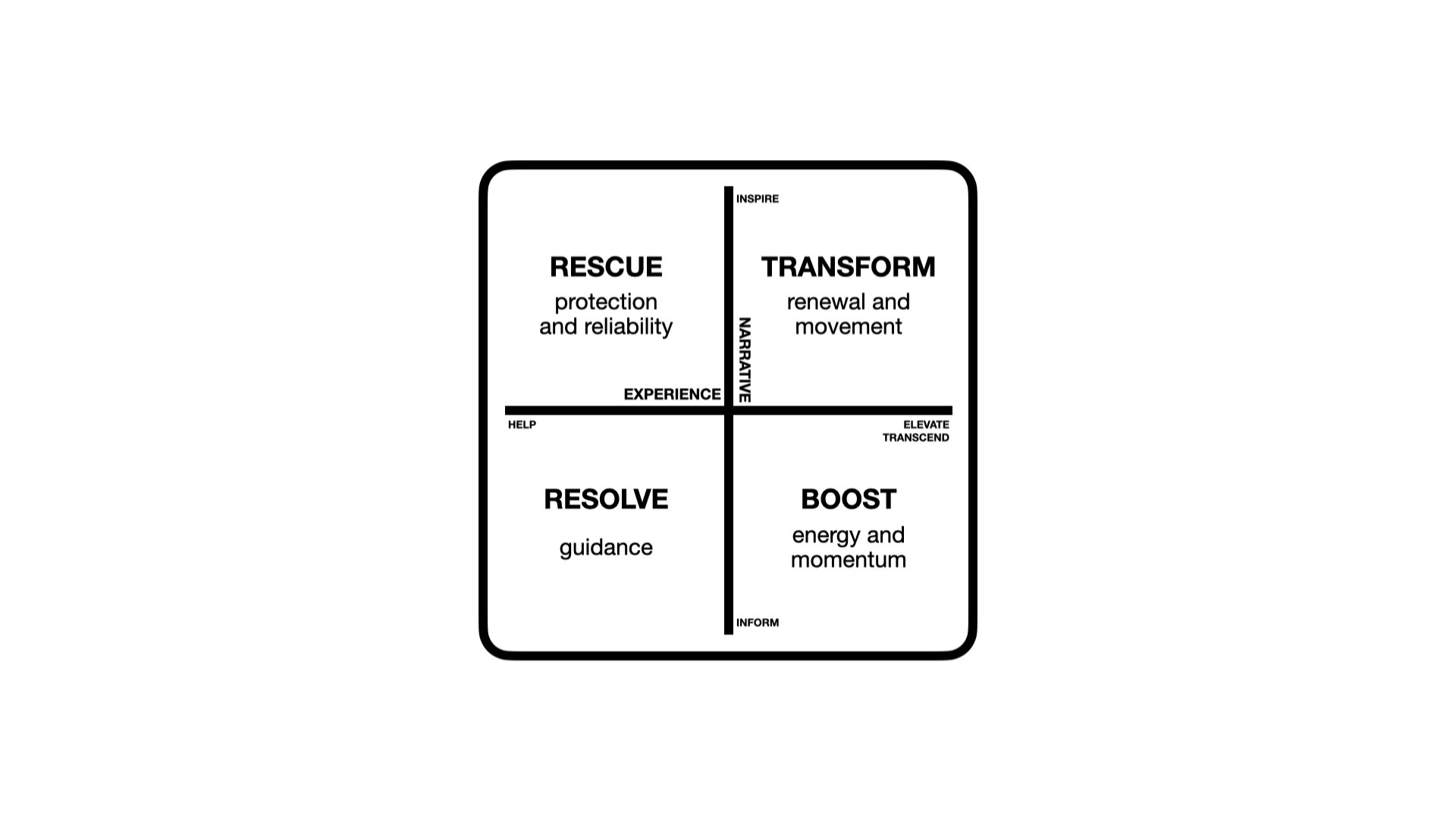
This matrix becomes a decision tool when you use it to look at your own trajectory. Where do you consistently create impact? Which quadrant reflects your lived experience rather than your aspiration? Which narrative tone emerges naturally from the way you think and speak?
Symbolic coherence emerges when these elements align. You recognise the archetype that reflects what you consistently represent through your lived experience and impact.
At that point a more demanding question appears: what do I represent in the lives of others, again and again?
Your answer defines your symbolic dimension.
Once you identify it and realise that it resonates strongly with your public, it becomes a strategic lever. You can consciously reinforce it through your positioning, your content choices and your visible signals. You start shaping perception at a deeper level, in areas that are processed intuitively and emotionally and therefore carry much more weight over time.
This is also the moment when you enter the territory that Roland Barthes describes as myth making. Myth, in his sense, describes the process through which repeated fragments of reality acquire a larger cultural meaning. When you consistently project a symbolic dimension, you tell small stories that expand in the mind of your audience.
Consider Yuval Noah Harari.
Harari presents himself as a sage in the ancient sense of the word, someone who can discern long historical patterns and interpret where we might be heading. He repeatedly frames contemporary issues through the long arc of human history and speaks about technology, politics and power as forces that may redefine what it means to be human.
Within the Experience–Narrative matrix he clearly sits in the Transform quadrant. His experience dimension lies in transforming mental models. His narrative dimension lies in civilisational foresight and warning.
He does not need complex personal anecdotes to build that identity. A small number of recurring themes is enough: the historian who connects past and future, the thinker who warns about technological acceleration, the observer who reads humanity at a species level. Over time those fragments expand in the minds of his readers and listeners, and he becomes more than an academic voice. He becomes a representational figure.
This is how symbolic leadership takes shape.
Designing your symbolic language
Once you are clear about what you symbolise, you need to pay attention to how that symbolism is communicated.
Roland Barthes and Umberto Eco remind us that meaning emerges through systems of signs, and that what surrounds an action often shapes its meaning as much as the action itself. The context in which you appear, the role you play, the associations you cultivate and the environments you choose all contribute to how you are interpreted, because your public presence is constantly being read as a coherent whole.
In practical terms, symbolic language shows up in very concrete ways:
The role you play at an event communicates something about your relevance.
The people you are seen with communicate belonging and status.
An award communicates legitimacy.
A certification communicates competence.
An institutional affiliation communicates authority.
The metaphors you repeat and the tone you sustain contribute to the constellation of meaning that surrounds you.
These elements are processed quickly and emotionally. They reinforce or weaken the symbolic dimension you have chosen to cultivate.
Symbolic language therefore becomes part of your architecture, shaping the structure of how you are perceived and how meaning gradually builds around you over time.
Two strategic decisions
Working with symbolism ultimately leads to two decisions.
The first is about identity. What type of symbol do I want to embody based on the impact I truly create?
The second is about design. What constellation of symbols characterises my public presence and consistently reinforces that identity?
When these two layers align, your name evolves from a reference to your competence into a representation of what you stand for.
The final question is simple and subtle at the same time: what story am I quietly planting in the mind of my public?
Symbols are always operating. Strategy consists in shaping them with coherence and intention.